Skip to Main Content
  • English 
  • Deutsch 
  • Linde Worldwide
  • About Linde
  • Linde, Making our world more productive Linde, Making our world more productive
  • Engineering

  • Your partner for the production and processing of gases.
  • About Linde Engineering
      • Executive Leadership Team
        • Stefano Innocenzi
        • Dominic Cianchetti
        • Michael Ullrich
        • Alexander Unterschuetz
        • Juergen Nowicki
        • John van der Velden
        • Tilman Weide
      • Locations
        • Linde Engineering Dresden
        • Linde Engineering Schalchen Plant
        • Selas-Linde GmbH
        • Linde Kryotechnik AG
        • Cryo AB
        • Cryostar SAS
        • Linde CryoPlants Ltd.
        • Moscow Representative Office
        • Linde Engineering Rus, OOO
        • Linde Engineering North America Inc. - Tulsa, Oklahoma
        • Selas Linde North America
        • Linde Engineering North America Inc. - Houston Office
        • Hydro-Chem, a division of Linde Engineering North America.
        • Linde Engineering India Pvt. Ltd.
        • Linde Engineering (Hangzhou) Co., Ltd.
        • Linde Engineering (Dalian) Co., Ltd.
        • Linde Arabian Contracting Co. Ltd.
        • Linde Engineering Middle East LLC
        • Linde Engineering Korea Ltd.
        • Linde Engineering South Africa (Pty) Ltd.
      • Quality, Health, Safety & Environment (QHSE)
        • QHSE at construction sites
        • Certificates and awards
      • Success Stories
  • Process plants
      • Air separation plants
        • Customized air separation plants
        • Modular air separation plants
        • Containerised air separation plants
        • References
      • LNG and natural gas processing plants
        • Liquefied natural gas (LNG)
        • Natural gas liquids (NGL)
        • Helium recovery and liquefaction
        • Nitrogen rejection
        • References
      • Hydrogen and synthesis gas plants
        • Gas products
        • Gas generation
        • Gas processing plants
        • References
      • Petrochemical plants
        • Steamcracking technology
        • Acetylene recovery technology
        • HydroDeAlkylation (HDA)
        • Linear alpha olefins (LAOs)
        • Polyolefin plants
        • Third-party technologies
        • References
      • Adsorption and membrane plants
        • Membrane plants
        • Hydrogen recovery and purification
        • Oxygen generator plants
        • Nitrogen generation
        • Carbon dioxide removal and purification
        • References
      • Cryogenic plants
        • Helium liquefiers
        • Helium refrigeration plants
        • Hydrogen liquefiers
        • Helium recovery systems
        • Equipment and accessories
      • CO₂ plants
        • CO₂ purification and liquefaction
        • Carbon capture
        • References
      • Furnaces, fired heaters and incinerators
        • Steam reformer furnaces
        • Cracking furnaces for ethylene production
        • Cryogenic vaporiser
        • Fired heaters and waste heat recovery units
        • DRI heaters & special crackers
        • Incinerators and thermal oxidisers
      • Linde Hydrogen
  • Plant Components
      • Plate-fin heat exchangers (PFHEs)
        • Plate-fin heat exchangers – Design variants
      • Packaged units / coldboxes
      • Cryogenic columns
      • Coil-wound heat exchangers (CWHEs)
      • Cryogenic tanks
        • Customer Information Centre
      • Air-heated vaporisers
      • Water bath vaporisers
      • Spiral-welded aluminium pipes
      • Helium storage tanks
      • UN portable tank (HELICS™)
      • Operational services
      • Hydrogen fueling technologies
  • Services
      • Engineering
        • Modularisation
      • Procurement
        • Supplier portal
        • Our Expectations to Suppliers
        • Supplier Collaboration
        • Supplier Qualification
      • Construction
      • Export and project financing
  • Innovations
      • Virtual reality redefines plant engineering
      • Innovative dry reforming process
      • FlexASU®
  • Linde PLANTSERV
      • Know-how and experience
      • Reliability
      • Efficiency and performance
  • News & Media
      • Press Releases
      • Linde @ Social Media
        • Facebook
        • Twitter
        • YouTube
        • LinkedIn
        • Miscellaneous
        • Social Media Guidelines
      • Events
        • Europe Industrial Gas Summit 2020
        • CIS Gas Monetisation
        • CIS Petrochemicals
        • GPA Spring Conference 2020
        • Gastech 2020
        • North America Smart Energy Week
        • FC Expo 2021
        • Hannover Messe 2021
        • ACHEMA 2021
  • Careers
      • Work @ Linde
      • People @ Linde
        • License to Fill
        • Matthias & the Mechanics
        • Spark of genius
        • The Pathfinder
        • Giving Back
      • Roles @ Linde
        • Engineers & Technicians
        • Sales & Customer Service
        • Healthcare & Homecare
        • Corporate Functional Staff & Admins
        • Operational Staff, Fillers & Drivers
      • Jobs @ Linde
        • Locations worldwide
      • Students & Graduates
        • School Students
        • University Students
        • University Graduates
      • Apply @ Linde
      • Job Blog
        • Insider Tips
        • Shell Eco-marathon
        • Shell Eco-marathon London
        • A whole new weld
        • Mission: Impossible
        • Into the future: at the push of a button
        • Get with the programme
        • Shell Eco-marathon: Learning from the young
        • Many cultures, one company: Linde Global Services
        • Spark of genius
        • Commissioning engineers
        • International Womens Day at Linde
        • Linde has a plan: and it includes everyone.
  • Contact
  •  
  • Language
    • English
    • Deutsch
  • Linde Worldwide
  • About Linde
  • About Linde Engineering
  • Success Stories
  • Efficient recycling of purge gas
Collaborate (XXL). Page header: 1936 x 660px.This image is a ready-made PNG file. It is intended for the use of the collaborate innovate deliver website – and is not suitable for any other purpose. The picture used is ID: 101164.

Recovering purge gas

Revamping ammonia plants

Ammonia ranks as one of the world’s most important base chemicals. All industrially manufactured substances containing nitrogen are based on this compound with the chemical formula NH3. Much of the ammonia produced globally is used for the manufacture of fertilizers, as much as 85 percent in fact. Other industrial uses include the production of nitric acid and polyamides. Every year, around 146 million tonnes of ammonia is produced, with China and Russia leading the way. “In a highly competitive industry, many operators of ammonia plants are looking for ways to make their processes more efficient,” says Christoph Weise, sales project manager at Linde Engineering Dresden. “We can help them do that by recovering valuable gases from ammonia synthesis purge gas streams.”

A variety of valuable gases going to waste

The industrial-scale synthesis of ammonia produces a purge gas stream. Depending on the process used by the ammonia manufacturer, a typical purge gas stream contains around 60 percent hydrogen, 20 percent nitrogen, five percent argon, four percent ammonia and ten percent methane, which has a negative impact on the catalytic ammonia synthesis reaction. The diverse range of gases produced is attributable to the feedstock, as Weise explains: “Natural gas is used to produce NH3. Following upstream process steps, it ultimately acts as a source of hydrogen. The required nitrogen comes from the air, which of course contains many other gases. Purge gas therefore contains various gas components which do not contribute to ammonia synthesis.”

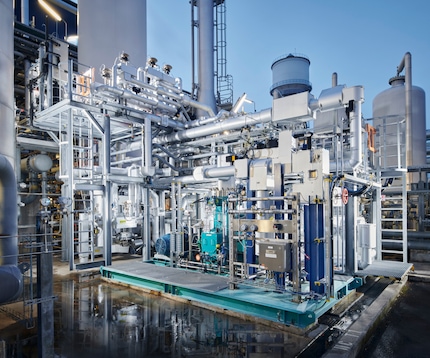
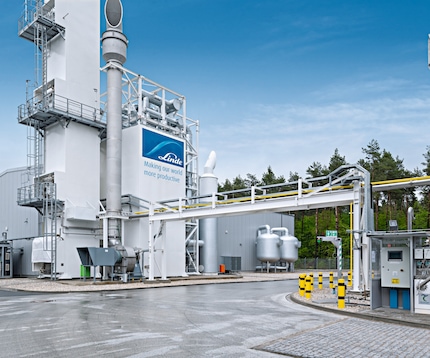
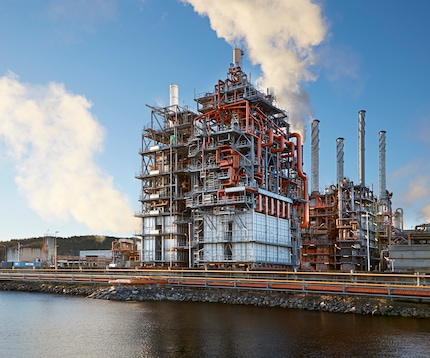
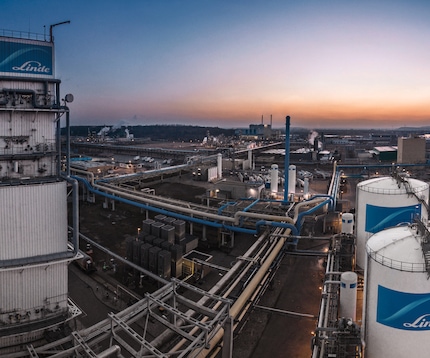
Plant to recover hydrogen from the purge gas stream from an ammonia production facility in Moron, Venezuela

Purge gas – more than a source of energy

Purge gas must be continuously removed from the process cycle. In the past, plant operators generally just burn it off as a source of energy. However, Linde experts believe that the constituent gases are too valuable to be disposed of in this way. With its purge gas recovery technologies, Linde Engineering Dresden offers ammonia manufacturers a number of options to recover and re-use components from the gas mix. The company can draw on decades of experience in purge gas recovery: Linde experts have been planning, building, delivering and commissioning these plants since 1958.

Cryogenic plants and membrane plants

“Our portfolio now includes a wide range of reliable technologies which we can adapt to the specific requirements of operators, thus indirectly improving the efficiency of their ammonia operations,” says Weise. “Instead of burning off the purge gas, our solutions are able to separate the ammonia, hydrogen, nitrogen and argon.” The most suitable Linde technology depends on the composition of the purge gas in question and the particular constituent gas or gases the operator wishes to recover. Linde Engineering Dresden differentiates between cryogenic plants and membrane plants. “The choice depends on whether only hydrogen is to be separated from the purge gas or whether argon, nitrogen or ammonia are also targeted,” explains Weise.

Optimal separation of gases

The largest constituent of purge gas, hydrogen can be fed directly back in to the ammonia production process. This makes it particularly valuable for plant operators. The gas can be recovered either by using a membrane process or a cryogenic process. With the first method, the gases are separated through fine pores in a two-stage process. Before the gas mix passes through the membrane, the ammonia has to be separated with a gas scrubber. In the cryogenic process, the gases are separated by means of heat exchangers and a separator in a coldbox. Linde offers two different process options here. Depending on whether only hydrogen is to be separated or whether nitrogen and argon are also required, the process comprises multiple stages and additionally includes rectification columns within the coldbox.

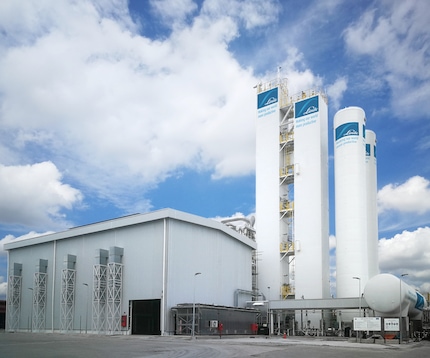
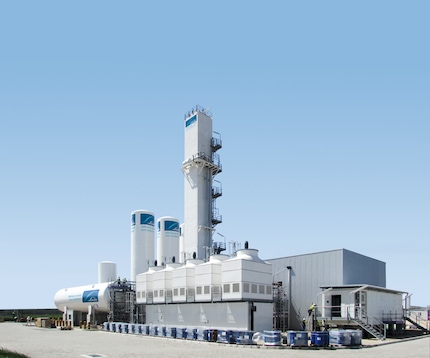
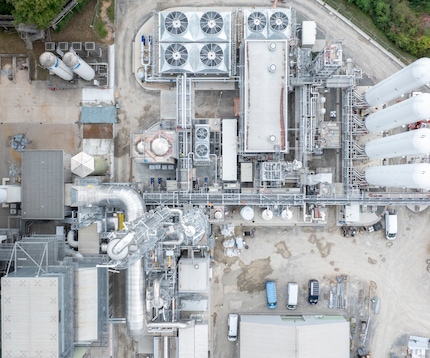
Plant to recover liquid argon from the purge gas stream from an ammonia production facility in Hazira, India

High-purity gas recovery

Ultimately, the ammonia manufacturer’s requirements will determine which of the two technologies is most suitable. “For example, the pressure of hydrogen recovered from the purge gas stream and its level of purity are key decision criteria for manufacturers,” the Linde expert explains. Nitrogen and argon can only be recovered by means of cryogenic separation. The operators obtain these gases with a very high purity level, however, for example up to 99.999 percent in the case of argon. Both gases can either be put to other uses in chemical plants or sold.

Revamping old plants

“A purge gas recovery plant usually pays dividends if ammonia production generates hourly purge streams of around 6,000 standard cubic metres,” says Weise. “Nowadays, a recovery unit is usually directly incorporated into new ammonia plants. However, a revamp may still be a worthwhile investment, even with older plants.” Since Linde’s technologies can be easily integrated into existing plants, the recovery of hydrogen, argon and nitrogen is an interesting avenue enabling ammonia producers to remain competitive in the long term.

Downloads
Brochure - Purge gas recovery(PDF 2.0 MB)
  • About Linde Engineering
  • Success Stories
Any questions?
  • Contact

    Contact us
More Information
  • Purge gas recovery
    • LinkedIn Social Media icon
    • Twitter Social Media icon
    • Facebook Social Media icon
    • YouTube Social Media icon
    • Xing_Social_Media_icon
    • Sitemap
    • Terms of Use
    • Legal Notice
    • Data Protection
    • Cookie Policy
  • © Linde 2020